Private equity, independent sponsors and search funds
Diligence on the books themselves, without becoming a user in them.
Before an LOI, no seller will give you a QuickBooks login. After it, a login is more access than you want: everything you can see is something you can be asked about. FinShare gives you the reports and nothing else.
How it goes today
Getting the numbers shouldn't mean getting into their books.
Pre-LOI, you get summaries
A P&L someone typed into Excel, rounded to the thousand, with the add-backs already in it.
Post-LOI, you get a login
A seat in the seller's QuickBooks that someone has to scope, monitor and remember to remove.
Spreadsheets don't foot
Pasted exports with a missing month, or a general ledger cut off because it was too big to export in one go.
| Exports by email | A QuickBooks login | A FinShare request | |
|---|---|---|---|
| What you can see | Whatever they decide to send | Their whole accounting system: payroll, owner draws, every customer and vendor | Only the reports on the list they approved |
| What you can change | Nothing, though anyone can edit the file before it reaches you | Whatever the user role allows, often more than reports | Nothing. FinShare only reads reports |
| Can you trust the file? | Basis, dates and columns vary; cells can be typed over | Yes, if you export it yourself, correctly, every time | Checked against QuickBooks' totals before you see it |
| When it ends | Never starts, so it never ends | When someone remembers to remove you | On the date the owner approved, automatically |
| What you're holding | Spreadsheets of uncertain origin | Credentials to someone else's books | Files, with a record of who approved them |
- What you can see
Exports by emailWhatever they decide to send
A QuickBooks loginTheir whole accounting system: payroll, owner draws, every customer and vendor
A FinShare requestOnly the reports on the list they approved
- What you can change
Exports by emailNothing, though anyone can edit the file before it reaches you
A QuickBooks loginWhatever the user role allows, often more than reports
A FinShare requestNothing. FinShare only reads reports
- Can you trust the file?
Exports by emailBasis, dates and columns vary; cells can be typed over
A QuickBooks loginYes, if you export it yourself, correctly, every time
A FinShare requestChecked against QuickBooks' totals before you see it
- When it ends
Exports by emailNever starts, so it never ends
A QuickBooks loginWhen someone remembers to remove you
A FinShare requestOn the date the owner approved, automatically
- What you're holding
Exports by emailSpreadsheets of uncertain origin
A QuickBooks loginCredentials to someone else's books
A FinShare requestFiles, with a record of who approved them
With FinShare
The reports without the login.
Ask for exactly what you need
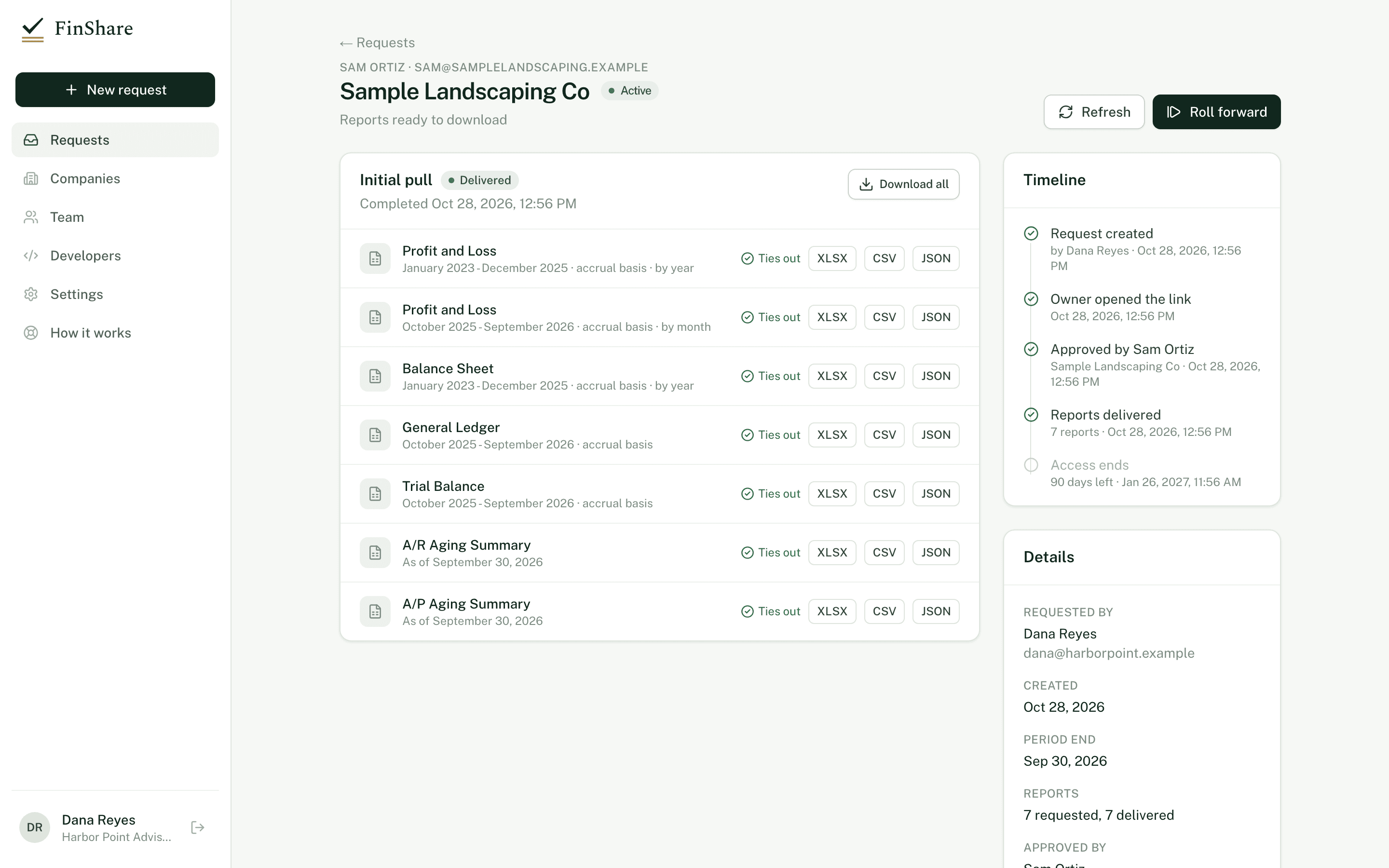
Three years by month, the general ledger in full, agings in detail, sales by customer. The seller sees the list and approves it.
Large ledgers handled
The general ledger is pulled month by month, split further if QuickBooks truncates a piece, and the pieces are checked for gaps and overlaps.
Traceable to the source
Raw QuickBooks responses are kept as immutable snapshots. Through the API you can fetch the raw response behind any report.
Through closing
Roll forward to the latest month before signing and again before close.
Start from
The packages most teams like yours use.
Built into the new-request screen. Change any report or period before you send.
Due diligence
What a buyer or advisor needs to start.
- Profit and Loss, last 3 fiscal years, by year
- Profit and Loss, trailing 12 months, by month
- Balance Sheet, as of period end
- General Ledger, trailing 12 months
- A/R Aging Summary
- A/P Aging Summary
Quality of earnings
Everything a QoE analyst rebuilds from.
- Profit and Loss, 36 months, by month
- Balance Sheet, 36 months, by month
- General Ledger, 36 months
- Trial Balance, last 3 fiscal years
- Cash Flow, 36 months, by month
- A/R Aging Detail
- A/P Aging Detail
- Sales by Customer, 36 months, by year
Questions
Common questions.
- Will the seller agree to this?
- It is an easier ask than a login. They see each report and period you want, the access window and the promises FinShare makes, then approve. They can revoke at any time.
- How big a general ledger can FinShare pull?
- FinShare pulls the general ledger in monthly pieces and splits any piece QuickBooks truncates until it fits, then joins and checks them. Very large ledgers take longer, but they arrive complete or not at all.
- Can my QoE provider get the files?
- Yes. Download and share them, or add your QoE team to your FinShare account so they can download directly.
Reading
Related articles.
Diligence · 6 min
Using the general ledger in a quality of earnings review
What the general ledger shows in a quality of earnings review, a practical Excel workflow, and why large QuickBooks GLs come back truncated or doubled.
Diligence · 8 min
Financial due diligence request list: What to ask a seller for
The QuickBooks reports to put on a due diligence request list, report by report: P&L, balance sheet, GL, trial balance, agings, periods and basis.
Reporting · 8 min
What 'tie out' means for financial reports, and checks to run
What it means for a financial report to tie out, and the checks that catch a bad file: assets = liabilities + equity, debits = credits, subtotals.
Send your first request today.
Sending a request is free; you pay only when the owner says yes. Nothing to install, and the owner needs only QuickBooks Online.